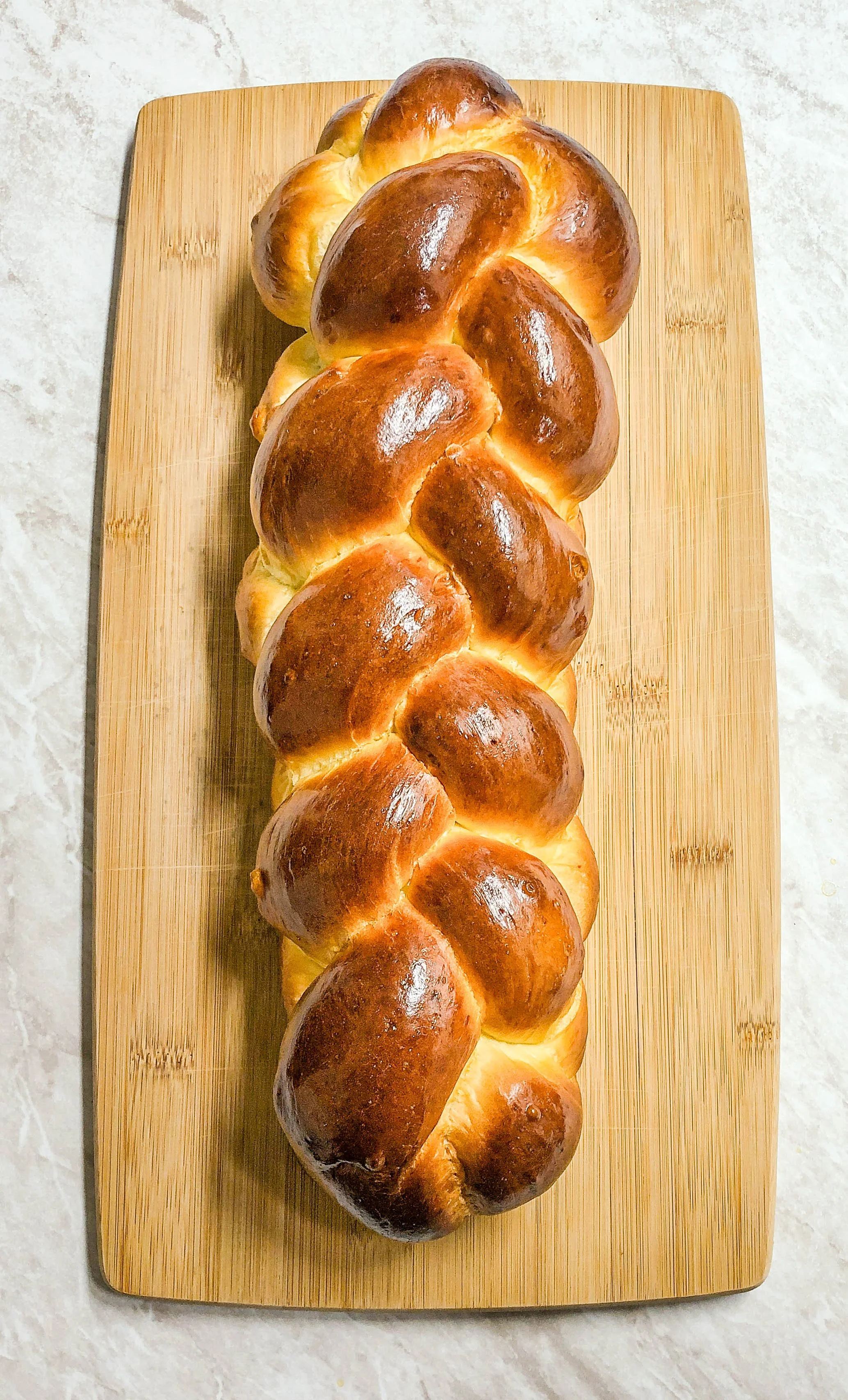
Our Daily Bread - Challah
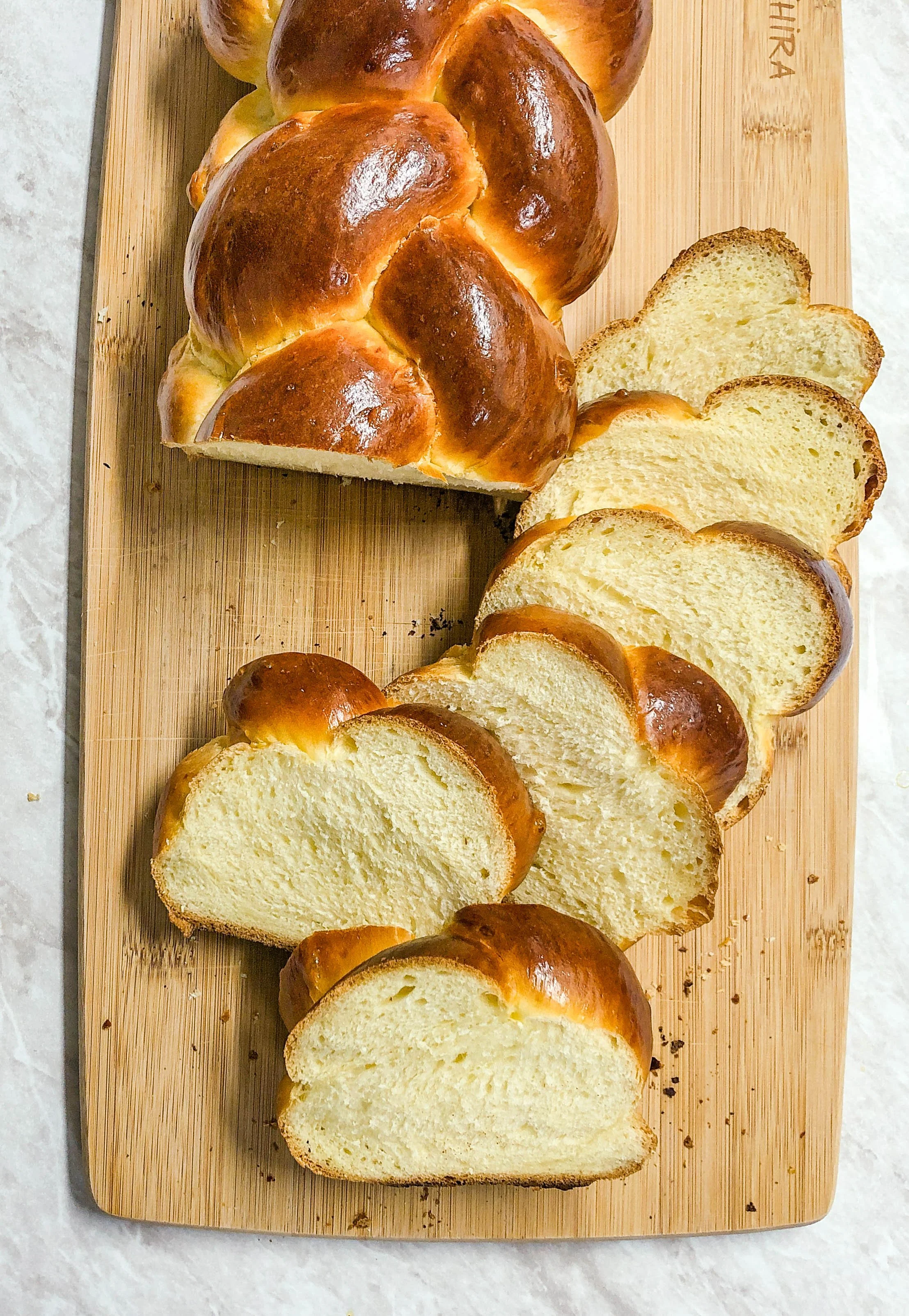
Tender eggy bread with a nice chew, gentle sweetness and tight crumb.
Challah
Makes 1 large loaf
My mom’s coworker of nearly 20 years was a Jewish woman named Frieda. Through her, my interest in Jewish culture was nurtured through books she suggested, foods to try and recipes to make since she knew I liked to cook. The first and only yeast bread I made before culinary school was a challah when I was 12 or 13. That first challah was one Frieda had been using at the time that she cut out of the newspaper and gave to my mom just for me to make. I cherished that recipe for years though I never made it again and it was unfortunately lost. This recipe is one I’ve modified to reach the standard of that challah I had only once in my life. In attempting to stick to everything I remember about that original loaf, challah is one of the only breads I do not use a preferment or scald or overnight rise for. I also do not add butter which is not traditional as the dairy mixing with meat in a single meal is not acceptable for eating Kosher. I’ll be honest, I’m actually not that great at braiding challah. I use a Youtube tutorial every single time I make one so my braid is right. Because of this I don’t give specific instruction on how to do so. I suggest using Youtube to find a braid you like and following that tutorial. My preferred braid is the 4-strand and the best video I’ve ever followed is (here).
“Recipe Tips:
*1. There are many different ways to braid and shape a challah. A simple 3-strand braid or 6-strand braid or braided loaf. For braiding instruction and variations, I suggest searching Youtube as I’m not an expert.”
Ingredients
150ml (0.75 c) warm water, divided into 100ml (0.50 c) and 50ml (0.25 c)
8g (2 t) kosher salt
520g (4 c) bread flour
70g (0.25 c + 2 t) granulated sugar
5g (1.25 t) instant yeast
3 large eggs
60ml (0.25 c) vegetable oil
Finishing
1 egg beaten with 1 t water
Sesame or poppy seeds - optional
Method
Day One
1. In a medium bowl dissolve the salt into the 100ml of water.
2. In a large mixing bowl combine the flour and sugar mixing well.
Make a well in the center of the flour.
Add the eggs, yeast and salt water. Mix until homogenous and the yeast is dissolved.
Mix the flour into liquid to make a dough.
Add the remaining water as necessary to make a medium-soft dough.
Turn the dough onto an unfloured work surface and knead for 2 minutes.
Return to the mixing bowl and add the oil. Squeeze the oil into the dough until fully combined.
Turn the dough onto an unfloured work surface and knead for 12 - 15 minutes or until smooth and soft.
The dough will be sticky but do not add additional flour while kneading instead use your bench scraper to scrape the work surface and switch between a regular kneading method and slap and fold as necessary.
To slap and fold: place your hands at 12 o’clock and 6 o’clock on the dough, lift up and turn a quarter turn (your hands will be at 3 and 9) “slap” the bottom of the dough against the work surface. Stretch the dough in your hands toward yourself and “fold” or “throw” the dough over the dough on the table. Quickly remove your hands from the dough and place your hands at 12 and 6 again and repeat for the time period listed.
Return the dough to the bowl.
Cover and ferment for 30 minutes.
Fold.
To fold: wet your dominant hand and loosen the dough from the bowl flipping the ball of dough over. Press out the dough to even out its thickness. Grab a grip of dough across from you, lift and stretch the dough out a few inches (or until you feel tension, you do not want the dough to tear) then fold it over the center. Turn the bowl 90 degrees and repeat this process, wetting your hand as necessary to prevent sticking, until you reach the point where you began. The dough should have formed a ball at this point. Flip the ball again, placing the “seams” of the dough on the bottom and tuck the dough together to make a ball.
Do not add flour during the folding.
Refrigerate overnight.
Day Two
3. Place a piece of parchment onto a rimmed baking sheet. Set aside.
4. *Punch dough down and divide into equal portions.
The number of portions you divide your dough into will depend on how many strands you want to braid. I prefer a 4-strand braid for the additional height but a basic 3-strand braid or something more complicated all work.
Preshape the portions into logs and let sit covered loosely for 15 minutes.
To preshape into logs: flatten and bring in the left then right sides to make a loose rectangle. Starting at the top, roll down to make a log.
Working with one portion of dough at a time, roll into a 38cm (15 in) strand on an unfloured work surface.
Repeat until each dough portion has been rolled.
Lightly dampen each strand of dough to make it slightly tacky then braid strands as desired rolling the ends together and tucking under the loaf.
Place the braided loaf onto the prepared baking sheet.
Cover loosely with oiled plastic wrap and allow to rise for 60 - 90 minutes or until the loaf doubles in size.
Because of the amount of enrichment, the dough can take as much as 2 – 2.5 hrs to rise depending on the temperature.
I prefer to egg wash my challah twice for a darker colored final loaf. The first egg wash is here before loosely covering with plastic wrap for the rise.
I like to apply the egg wash with a paper towel as I feel I get better coverage on the nooks and crannies but a brush can be used.
For a lighter colored loaf, only egg wash right before baking.
5. When the loaf is almost finished rising, preheat oven to 180 C / 350 F.
Egg wash dough and sprinkle with seed if desired.
Bake for 25 – 35 minutes or until an internal temperature of 94 C / 201 F.
Without a thermometer, when tapped along the bottom of the loaf, it should sound hollow.
If the loaf is darkening too quickly during baking, cover with foil.
Remove the loaf to a cooling rack.
Allow to cool to room temperature or until barely warm before slicing.
6. Serve.